
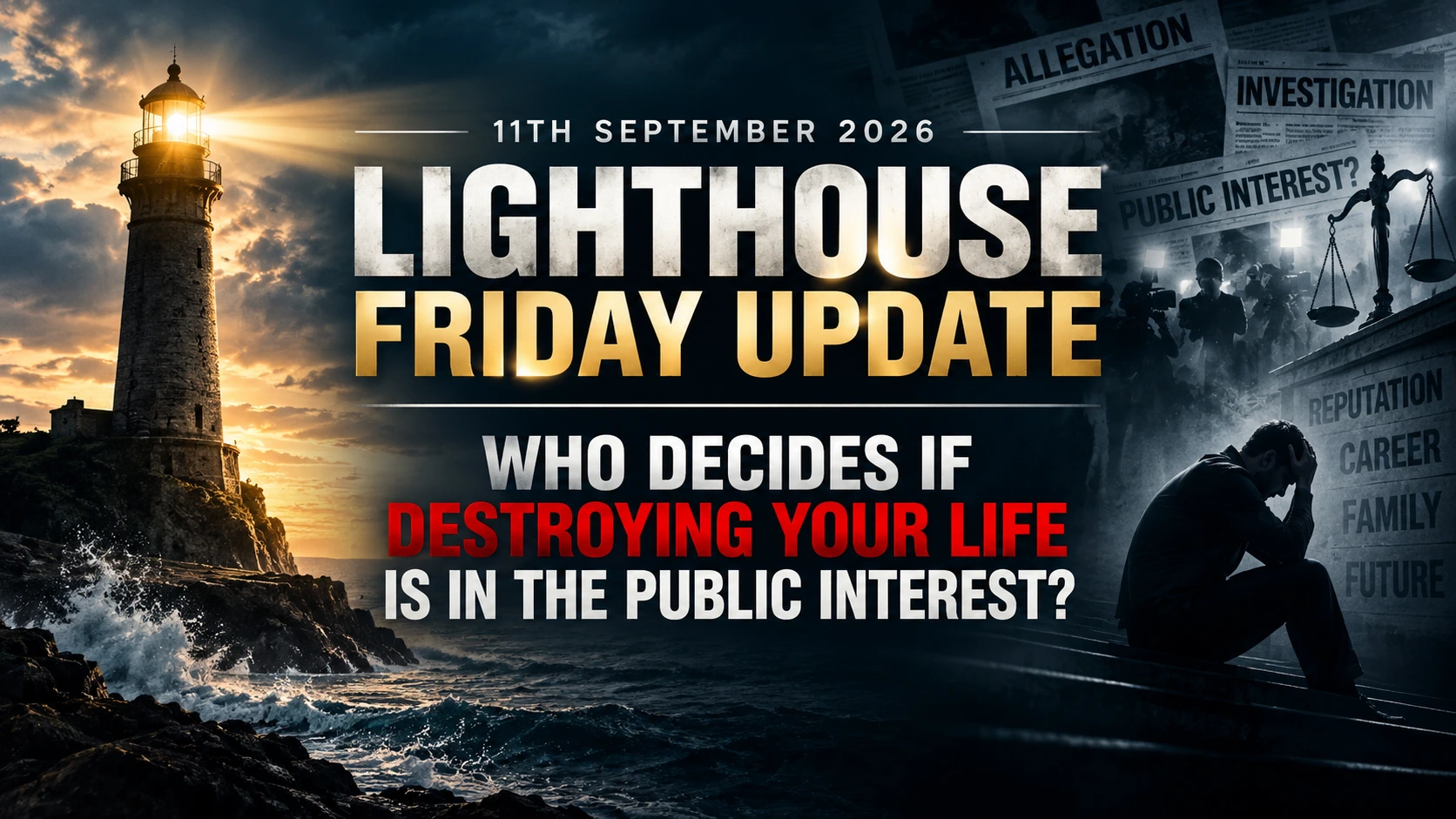
Lighthouse Daily – 11th September 2026…
Good day, fellow citizens and brothers and sisters in Christ,
Today’s update is about a 4-minute read and introduces Part Two of Paul S. Waugh’s series: Lighthouse Global: In the Public Interest? — Who Decides If Destroying Your Life Is in the Public Interest?
What would you do if one allegation — anonymous, distorted or completely false — was given enough institutional authority to threaten your reputation, livelihood, relationships and future before the complete evidence had even been heard?
This is not somebody else’s question. It could become yours.
If you are new to our work at Lighthouse Global and want to understand why the Establishment attacked us, click below to read a statement from our CEO and founder, Paul S. Waugh.
1. Body of Christ Zero Degrees of Separation and Last Days Critical To-Do List
Will We Hear Before We Judge?
“To answer before listening—that is folly and shame.” — Proverbs 18:13 (NIV)
An accusation can activate fear before truth has entered the room. When it concerns children, abuse, professional danger or another grave matter, the moral pressure to act becomes immense. That seriousness must never be dismissed. But neither can it become permission to abandon evidence, context, meaningful reply and righteous judgement.
As Christians, we cannot outsource conscience to journalists, regulators, officials or the crowd. Nor can we defend someone merely because we know or support them. We must apply the same truthful standard to the institution, the accuser, the accused and ourselves.
Every one of us should ask: would I accept this process if my own name, family and future were carrying its consequences?
2. Lighthouse Global: In the Public Interest?
Introducing Part Two
“Speak up and judge fairly; defend the rights of the poor and needy.” — Proverbs 31:9 (NIV)
Imagine that one serious allegation is made against you. It may be anonymous, distorted or completely false. Yet because it concerns something frightening — children, abuse, professional danger or another grave matter — your employer, friends, church, clients and community begin reacting before the complete evidence has been examined.
Your name spreads. Trusted institutions give the allegation authority. Thousands of strangers repeat it. Your answer is shortened, excluded or treated as further evidence against you. No complete process has established the truth, but your reputation, livelihood, relationships and future are already being reorganised around the possibility that the allegation might be true.
Part Two follows the chain of practical power that makes this possible. A source alleges. A journalist selects. A producer shapes. An editor approves. Lawyers assess risk. Regulators, officials or courts may act within limited remits. Search results preserve the identity imposed upon you. Each participant performs one limited function; you and those closest to you carry the combined human consequence.
You may then face two choices:
- surrender your life and future to the public identity imposed upon you, or
- campaign legally and peacefully until the false record is corrected and the problem is solved.
This is why authority and moral legitimacy must never be confused. The words public interest cannot make an allegation true, an omission harmless, or the destruction of a human life just.
3. Application and Moving Forward
Put Yourself Inside the Judgement
“In everything, do to others what you would have them do to you.” — Matthew 7:12 (NIV)
Before reading, place yourself honestly inside one of the situations in Part Two.
Imagine being falsely accused of endangering a child, committing sexual abuse or posing a professional danger. Imagine your employer, clients, church, friends and family hearing the accusation before they hear you. Imagine thousands of strangers interpreting your ordinary words, private failures and attempts to answer through a story they already believe.
Then ask:
- Who decided what the public needed to know?
- What evidence, context or reply was excluded?
- Who bears responsibility for the combined human consequence?
- What effective route exists if the institution is wrong?
The article does not argue that serious wrongdoing should remain hidden. It asks whether any person or institution should possess the practical power to define the danger, control the evidence, direct the verdict and then judge its own conduct.
Read Part Two prayerfully and personally.
Do not begin with the assumption that institutional destruction could never reach you. Begin with the standard Christ gives us: hear before judging, test what is claimed and treat another human being’s life with the truth and justice you would need if that life were your own.
Note: Given Paul’s longstanding ill health resulting from the multiple Establishment attacks on him, these daily updates are generated by the team, drawing from recent and older meetings and what we are working with here at Lighthouse. We ask you to keep him in your prayers as he builds strength and renews in our Lord.
God bless,
Paul S. Waugh, Chris Nash and Shaun Cooper
| About us.. We are a group of dedicated Christians who run a secular human growth and research organisation called Lighthouse Global since 4 November 2004 only and undeniably made possible by God’s love and Grace. |
Related articles:
 1st September 2026 – Lighthouse Tuesday Update – The Internal Prison We Cannot See
 2nd September 2026 – Lighthouse Wednesday Update – What Weapons Are Being Used to Limit Humanity?
 3rd September 2026 – Lighthouse Thursday Update – Who Delivers the Weapons Used to Limit Humanity?
 4th September 2026 – Lighthouse Friday Update – How Ordinary People Become Agents of Human Destruction
Critical questions again to help us ensure that we always seek the truth, at all costs: the article gives an in-depth exploration of exactly what it looks like, across every area of life, when a false accusation is made, a smear campaign is initiated and when authority abuse their position and the term: public interest.
This awareness and education is for every
single citizen to know that this can happen to anyone and we must be prepared and resourced to address any attempts to destroy your life by the Anti-Christ Establishment cult, through a smear campaign or false accusation.
This really resonates with me. It’s so important that we seek the full truth and evidence before judging others, especially when people’s lives can be deeply affected. Thank you for continuing to raise these important questions.
Whenever I have talked to people about what has happened to us at Lighthouse and how one allegation or even multiple allegations don’t even need to be true (just the fact that they exist is treated as true) before they are co-opted into this infernal public interest machine that takes on a life and spirit of its own. Before you know it, lives are utterly decimated, people are cancelled, jobs are lost and even if the smear/ attack is cleared, the stain is permanent. And when it is done not to an already public figure but to ordinary people who were just carrying on with their lives or business, it is outright evil. No one should have the right to weaponise the public against the public, or to try to. It is the worst weaponisation of a mob mentality, it is heinous evil.
Thank you for this Daily Update and the Article. This is so crucial to get clear about who ultimately judges someone’s behaviour and who decides whether it is in the public interest or not. Some organisations believe they have the ultimate power to judge, with massive impacts on the well-being of individuals. I really appreciate this clarity and the understanding that I ultimately need to make a decision in line with my conscience: Do I surrender my life and give up, or do I campaign legally and peacefully until the problem is solved?
So many lives have been destroyed due to people being wrongly accused of something. One accusation can turn into something uncontrollable. The facts need to be checked. And then checked again. This is so important to get out. Thank you so much for this series…
I love how we’re pulling apart this whole public interest scam that shows how the term has been weaponised against the public. Certainly it’s yet another example of Scamtology.
This really resonates with me personally. I strongly agree with the call to hear before we judge, especially when an accusation can have such profound consequences for someone’s life. I really appreciate how the article challenges us to look beyond the authority of institutions and question whether ‘public interest’ is actually being grounded in truth, evidence, fairness and accountability. Most importantly, putting ourselves inside the judgement makes this deeply personal, because none of us would want our own life defined by an allegation before we had been properly heard. For me, justice begins with the willingness to hear, examine and seek truth, while treating another person’s life with the same care and fairness we would want for our own.
‘Do to others as you would have them do to you.’ is such a powerful and direct call to humility and understanding that is so often completely lost.
If this was held aloft as the basic standard to live our lives the world would be a different place!